Pages


My Mouth: All of It: One Man, One Place, All Said

On Facebook: Tales, storytelling, fables: http://facebook.com/AnthonyTrendl

Executive Speechwriting: Corporate, Weddings, Retirement

Showing posts with label review. Show all posts

Wednesday, August 5, 2015

Review: Meb For Mortals: How to Run, Think, and Eat like a Champion Marathoner


Worth Every Penny: Meb Knows His Stuff

As I was reading "Meb for Mortals," a non-runner friend saw it. "I don't know what a Meb is," she said. To runners, however, Meb Keflezighi is a household name. Why? Because he is winning in a sport we Americans haven't won very often. His credentials as a marathoner are long and deep. Even as he has turned 40, he is still among the best.

But why this book?

Meb finds that space between inspiring and informative.

It is unlike other distance running books. "Meb for Mortals" isn't filled with detailed workouts 18 or 20 weeks out from race day. Nor is it a long dissertation on the merits of a quality diet. And you won't find it going on and on about some philosophy of running. That said, there's a little of all that in here.

Ghostwritten by Scott Douglas, it is better than most other books on writing. Douglas is a senior content editor at Runner's World (same publisher as the book). The guy knows running and isn't just another hack.

Tony Dungy wrote the foreword. You can skip that. Dungy doesn't really say anything interesting or unique to his relationship to running or Meb. It feels sort of pasted on. But no worries, you are reading the book for the rest, not the foreword.

The chapters:
Think Like Meb
Run Like Meb
Train Like Meb
Race Like Meb
Eat Like Meb
Strengthen Like Meb
Stretch Like Meb
Cross-Train Like Meb
Recover Like Meb

Like the chapter titles imply, we get this from his point of view, from his personal experience as a runner. He's not (yet) a coach, nor does he necessarily have expertise in nutrition and so forth. But he wins. That means it is worth learning how one guy is getting it done.

Within each chapter, he relates the content to his own life. When discussing diet, he tells how much he weighed when, and what weight his physician told he should weigh.

Among the things you'll gain from this is a sense of his personal discipline. He stays on the game even when he's resting. By that I mean he takes seriously the process of making good choices. He doesn't take his success for granted. He reminds us of three simple keys in life:

Good goals
Commitment
Hard Work

This shouldn't be the only running book you read. Bob Glover's The Competitive Runner's Handbook: The Bestselling Guide to Running 5Ks through Marathons  is a great one, as is Hal Higdon's Marathon: The Ultimate Training Guide: Advice, Plans, and Programs for Half and Full Marathons. There are too many others to name, but Meb's book is worth your money and time.

Anthony Trendl
AmericanSpeechwriter.com

Tuesday, November 22, 2011

Once a Runner - Intriguing Read for the Literate Runner, Average for the Rest (review)

Unfortunately, "Once a Runner," John L Parker's legendary book about the plight of a runner, is ultimately forgettable.

It is a search for self and a search for meaning that drives the book, with an existential nihilistic, or, perhaps less philosophically, humanist gear pacing the reading through the selfish individualism of runner Quenton Cassidy. His goal is to both break the 4:00 barrier (a gold standard among milers) and to compete against the world's best. However, he has broken rules which bar him from racing in the key meet.

In general, it is well written. Occasionally has a literary quality, but then drops into average novel-of-the-moment phrasing. It captures the intensity and mindset of the runner fairly well. Drops a lot of the names of known runners (Pre, Liquori, Shorter, etc.)

As it was published in 1978 originally, that could be a problem. As a runner myself, I'm somewhat of a track nerd, and was reading "Runners World" in the late 1970s and early 1980s while those guys names and some of the running sub-culture was as described. Would the world who follows Hall, Cox, Haile (names, which in a few years, may be forgotten by the less-than-hardcore-runner) on the long distance side, or the crowd who watches Webb and so on -- would they 'get it'? The running boom was just kicking into high gear then. Jim Fixx's book, "The Complete Book of Running" had just come out. Coe, Cram, Ovett hadn't really gotten going. Marathons hadn't blown into mega events yet.

As a book, I wonder if non-runners would enjoy it? I'm not sure. I don't think that it transcends the niche audience/market the way Alan Sillitoe's "Loneliness of the Long Distance Runner" has.

Runners who read regularly will devour this, as might the endurance sports enthusiast. Its accolades will remain there. For the rest of the reading public, it is average, if not overdone.

Anthony Trendl
http://runnersdilemma.blogspot.com/

Wednesday, March 9, 2011

Timex T5J031 Unisex Digital Fitness Heart Rate Monitor Watch review: Timex Can Do Better: Never Use at Night

I ask one thing of the Timex T5J031 Unisex Digital Fitness Heart Rate Monitor Watch, and it delivers: count my pulse. What I did not expect is that it would be as accurate as it is.

I compared to various treadmills I run on, including Life Fitness Club Series Treadmill and found the watch more accurate than the handlebar pulse monitors.

* The chest straps fits well enough for me.
* Modes are easy to switch.
* The watch fits fine, but can be a little difficult to take off.
* My average heart rate worked well.
* Easy to use lap function. As mostly a neighborhood street and dedicate running/biking path runner, I use this when I cross the street.
* The Indiglo light is difficult to see - not especially bright, and the button for it is in a difficult to reach spot while running (top left as opposed to front). After a few miles, when I just a quick look, it can be a nuisance while running through a shady area. In fact, while lit, unless in a pitch black environment, the numbers are actually more difficult to see.
* The description says, "The Night Mode feature allows you to illuminate the Indiglo night-light for 3 seconds with any button press, regardless of the mode or function." I was unable to get this to work with any other button.

For the price, I would like to see better engineering. While I understand this is an entry level pulse monitor, set-up is an unnecessary challenge.

Anthony Trendl
http://runnersdilemma.blogspot.com/

Saturday, March 5, 2011

Life Fitness Club Series Treadmill: review - Good, But Overpriced Treadmill With Some Frustrations

The most important feature to me on a treadmill is footplant comfort. This nails it. If I run enough miles on a cheap treadmill, my Achilles and knees ache. However, there is more to a solid machine.

The Life Fitness Club Series Treadmill speed eases up smoothly and sensibly. It never jerks. Similarly, the incline is never abrupt. Very nice feature.

Life Fitness Club Series TreadmillThe heart rate monitor, the one on the handle bar, is sometimes inaccurate when compared to my Timex T5J031 Unisex Digital Fitness Heart Rate Monitor Watch. While it is only a few beats off, I expect a machine at this level to be better.

The buttons are an issue, reacting in a finicky, frustrating way. My make-do solution is, instead of fumbling with typing in numbers while running, I punch one of the walk-jog-run buttons, which takes me to a given speed. From there, I use the faster-slower button.

Entering my weight and speed and incline and it shows my calories burned. For me, this is just a curiosity, but it shows consistent data.

99% of the time, all I use it for is long long distance, up to 10 miles or so. For this, I am completely happy. There are plenty of other features I never use (the HeartSync workouts, for example). The buttons are a hassle, but once set, I'm good to run.

Anthony Trendl
http://runnersdilemma.blogspot.com/

Life Fitness Club Series Treadmill

Friday, November 12, 2010

Red Bandana: Do Not Run and Play Air Guitar & "Run to Overcome" by Marathoner Meb Keflezighi Reviewed

Do not, under any circumstances, play air guitar while running on a treadmill. You may sing, you may shout, but leave your air guitar skills for karaoke time at your Aunt Suzi's wedding.

For example, you rockers out there have no business trying to see if you can effective pretend to play "Freebird" by Lynyrd Skynyrd. And if I see any of you pointing your invisible electric guitar to the ceiling while moaning, "'Scuze me while I kiss the sky," ala Jimi Hendrix, I will, without hesitation, report you to the treadmill police. It is for your own good.

Why?

Just the other night, rocking out during a five mile run, working through a great selection of music for the evening. The Hollies, The Who, The Romantics, Wild Cherry, Kool & the Gang. Each song was crammed with testosterone, each more high energy than the previous. I was revved up. My gait and cadence were good. I started feeling like a real runner.

But then -- I started to sing. That's OK. This is my basement, not Chicago's L Train. That I cannot sing is not material. In fact, it is good training. New Zealand's famous coach, Arthur Lydiard, used to say one test for running a good aerobic pace is if the runner can talk. Singing is like talking, isn't it? Only moreso.

So I belted out a few tunes. My neighbors knew that "everyone was kung fu fighting" and "Those cats were fast as lightning." They now know, "What I like about you." And they did not need to hear that I was, "Dancing with myself," to know that, in fact, I was.

But then my playlist came to Bachman-Turner Overdrive. You oldies will know them simply as BTO. I'm a product of the 1970s. What could I do? When "Takin' Care of Business" hit my stereo, I was strumming and picking away. I did not limit my air musicianship to guitar. Piano too. There is a bit of boogie-woogie piano in there, and I don't think I missed a note.

Sometimes, I played both instruments at once. Piano on left, guitar on right.

You know the song. It begins:

"You get up every morning
From your 'larm clock's warning
Take the 8:15 into the city
There's a whistle up above
And people pushin', people shovin'"

Trouble was, I was running. Remember? Five miles. On a treadmill. I was strutting more than running (think Chuck Berry meets Mick Jagger meets Peewee Herman), switching between my piano and guitar duties, ripping out the lyrics like they mattered. I slipped and did a George Jetson.

I'm exaggerating some. It was a good run, I did sing to most of the songs. And I did play a little air guitar. Who wouldn't? However, I really did catch myself slipping not paying attention to the task at hand. I wasn't hurt. I might have been.

Pay attention while running. That is the entire point of this column today. Have a great time and feel even better as you do it, but never forget that hitting the wall behind you, or twisting an ankle is a bad idea. Be careful out there (and in your basement).

The Complete Running Playlist
1) Long Cool Woman (In A Black Dress), The Hollies
2) Happy Jack, The Who
3) What I Like About You, The Romantics
4) Play That Funky Music, Wild Cherry
5) Turning Japanese, Vapors
6) Takin' Care of Business, Bachman-Turner Overdrive
7) Celebration, Kool and The Gang
8) Kung Fu Fighting, Carl Douglas
9) Pinball Wizard, The Who
10) You Really Got Me, The Kinks
11) Feels Like The First Time, Foreigner
12) She's The One, Bruce Springsteen
13) Communication Breakdown, Led Zeppelin
14) Dancing With Myself, Billy Idol

Run to Overcome: Inspirational Story About Marathoner Meb Keflezighi

Meb humbly relates his life in this readable autobiography. He takes us through his childhood in Eritrea, a country not quite twice the population of Chicago. He describes facing soldiers and war, and how he saw death as a young boy. Through college at UCLA as well as his early career as a runner, we learn the life of an elite running is often difficult.

His beloved friend and fellow runner Ryan Shay dies while racing. Eritrean friends are murdered just before he visits them. A grocery store he owned with his family was robbed by armed thieves. His racing doesn't go well, and his income drops. His faith grew just the same.

He perseveres, and draws the reader into a world of running and and international culture.

Overall, "Run to Overcome" is honest and inspiring.
(full review on my website)

——————-
Writer Anthony Trendl loves BBQs, folk music and porches. He looks to running as he battles midlife and his mid-section. Find out more: http://anthonytrendl.com

For more about my running adventures, see A Runner’s Dilemma (workout details, videos and more): http://runnersdilemma.blogspot.com

The Red Bandana: Finding Fitness Through the Joy of Running

Thursday, November 4, 2010

Run to Overcome: An American Story of Marathoner Meb Keflezighi's Life

American marathoner Meb Keflezighi's last name is hard to say. Talk among runners, and mention, "Meb," and that's usually enough. "Run to Overcome" is likely to help it become a household name.

His claim to fame is his Silver Medal for the marathon, won at the 2004 Olympics, or his 2:09:15 time while winning the 2009 New York City Marathon. But that's not why this book matters. Other runners have run faster. Haile Gebrselassie owns the world record in 2:03:59. Cheering on Meb comes easier once you know the back story. In the midst of being all about a runner's life, it isn't about running. It is a Horatio Alger type story of rags-to-riches, full of hard times, hard work, and the blessing of God.

Like many immigrants, Meb's family left home to remain safe from war, and to find a better life. And like those families, things were difficult. And in the face of adversity, he found motivation.

When Tyndale House Publishers sent me this book, asking for a review, I wondered suspiciously if it would be like so many autobiographies with a "look at all I have achieved" attitude. Better written than expected, Meb humbly relates his life. He takes us through his childhood in Eritrea, a country not quite twice the population of Chicago. He describes facing soldiers and war, and how he saw death as a young boy. He tells how his parents taught him to trust God despite all of this.

After emigrating through Italy to the United States, his his American teachers made an impact, he says, as he mentions a note he still owns from a teacher encouraging him as an excellent student. His seventh grade PE class teacher had him run a mile, and his first time out, Meb ran a 5:20.

Meb enters UCLA, relating running and academic struggles, though ultimately succeeds at both.

Challenges continued, however, after college. First, does represent America or his home country? Injuries. Bad races. Psychologically beat up, he learns to dig deep and beyond whatever froze him, train smart to stay healthy, and find a way to win.

He admits when he ran one televised 10,0000 meter final, his girlfriend would be watching, "I wanted to impress her." He won by 19 seconds. He eventually marries her.

More races, more ups and down are found as Meb matures in his running career. His beloved friend Ryan Shay dies while racing. Eritrean friends are murdered just before he visits them. A grocery store he owned with his family was robbed by armed thieves. His racing doesn't go well, and his income drops. His faith grew just the same.

He applauds the many people he competes against, and recognizes his friends. Throughout the pages are pullout quotes by coaches, friends and runners who all repeat the quality of his character. Olympic legend Joan Benoit writes similarly in her brief foreword, reiterating it is an honor to call Meb her friend.

Overall, "Run to Overcome" is honest and inspiring. Runners will appreciate the race and training details, but nonrunners will find it readable. I fully recommend "Run to Overcome" by Meb Keflezighi.

Anthony Trendl

Thursday, September 23, 2010

Two For Runners: Headphone Review and Facebook Down To-Do Tips

What do you do when Facebook is down?

10 Silly Tips About How to Handle a Facebook Stall.
Includes a running idea for all you other well-intentioned folks

Nice sound, but they don't stay in the ears.

Saturday, May 3, 2008

Mix of Oprah, "Sports Illustrated" and "Running Times" - review "Runner's World

Runner's World [1-year]
Hardcore runners will read "Runner's World" because they have to. It popularizes the sport, and brings newcomers 'up to speed' about issues and techniques important to them, as well as clues them in on who is who out on the road. a great magazine, except I simply prefer the depth of training and racing issues Running Times provides a bit more. Really. I wish I could've given this magazine a 3.9.

Running is a funky subculture, and Runner's World defines and educates that culture.

Since the late George Sheehan wrote his famous column that emphasized running as a spiritual endeavor, Runner's World has taken on an Oprah Winfrey/Deepak Chopra sort of generalist running philosophy. That's not all bad, as I think the magazine thoroughly encourages fitness through running.

It isn't all fluff. There is plenty for the more avid runner to soak up. The avid runner will find their marathon coverage, especially Boston and New York, impressive.

Their running shoes review is what any runner will benefit from. It details every aspect of what makes a great shoe, almost to the point of parody. However, parody or not, their analysis will help you buy the shoe you need for your foot for your distance in your environment.

Buy a subscription to Runner's World, lace up, and get out on a run!

I fully recommend Runner's World.

Anthony Trendl
http://runnersdilemma.blogspot.com/

Tuesday, April 8, 2008

Rocky Balboa: Movie About a Boxer, Could Have Been a Runner (review)


Worthy Addition to Sports Movie Pantheon, Jan 31 2007
"Rocky Balboa" AKA, "Rocky VI" will not be the greatest inspirational sports movie you see. Its grandfather, the original "Rocky" could argue for that spot. In fact, it might own it. However, no one should compare this to the first Rocky. It is a fun, inspiring movie for 2006, and will be a worthy addition to the sports movie pantheon.

4.5 stars for this one.

"Rocky Balboa" is, itself, the great underdog. Critics see it as another installment in the descending and embarrassing series, or, are calling it the best 'Rocky' sequel. Because of the two extremes Stallone has presented us, from one of the best movies ever to some of the dogs of cinema, expectations are low. With expectations across the board, I saw this and was pleasantly surprised.

Rocky Balboa, circa 2006, is a retired boxer approaching 60. People in town generally give him respect, and space. He is no longer hounded by the media, and no longer chased by his fans. Philadelphia has moved. They even took down his statue.

Now, he runs a midlevel Italian restaurant, and wanders from table to table telling about the good old days. Customers get a meal and a story, and Rocky gets his mortgage paid.

His son begrudges his dad for the big shadow. Imagine being Michael Jordan's kid? Such is what Rocky, Jr. must endure, and he wants to be his man. He pushes his dad away in the process. Rocky's conversation with his son outside the restaurant will be ranked among the great movie speeches, and will be quoted everywhere from church sermons to business books to locker rooms.

Meanwhile, Rocky is looking for meaning. Like Willy Loman, he wants the older years of his life to matter, and like Loman, he keeps looking to the past to find that meaning. Regular visits to Adrian's grave, autographs in his restaurant, and walks through his old neighborhood remind him of who he used to be. Who is he now?

He feeds a needy old opponent of his, helps a single woman and her son with friendship and jobs. He recognizes that life should be lived on his terms, just as he always has. But what are his terms?

When reigning champ Mason Dixon, a mix of rap star arrogance and Mike Tyson dominance, wants to fight, Rocky sees it as similar to the opportunity Apollo Creed gave him decades earlier. He's a fool, naturally. The match "will against skill" is respectful that Rocky's will power is bar none, but he isn't 25.

Like the other Rocky movies, good and bad, this is a family film. No profanity, sex, or the usual Hollywood movie gimmicks to kick it into PG-13 or up rating. It's clean, hard-charging, and packed with the message the other movies carried: "All about: pride, reputation, and not being another bum in the neighborhood."

The movie needs another 10-15 minutes to wrap up some storylines, and some of the lines are cheesy. Dixon's desire to be tested, Spider's reasons for being out of work, and Rocky's friendship to Steps need clearing up. The movie hangs on, but viewers might be left unsatisfied. Rocky makes one monologue too many about continuing to fight and never be beaten, but not so much that it becomes polemic.

I fully recommend "Rocky Balboa."

Thursday, August 30, 2007

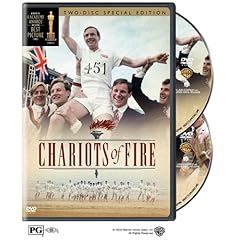
Chariots of Fire: Inspiring Story of Commitment, Faith and Glory

Chariots of Fire (Two-Disc Special Edition)

Many great sports movies are about self-sacrifice for the sake of selfish goals. Rocky Balboa (Rocky Balboa: Movie About a Boxer, Could Have Been a Runner (review)) fought to prove something. Lou Gehrig wanted to persevere. Rudy Ruettiger just wanted to play for Notre Dame. They have obstacles, and by sheer will, overcome them.

Not Eric Liddell. Liddell wanted to glorify God. When he ran, he felt closer to God. When it came to winning, he wanted it to point toward God, not himself.

When questioned about his commitment as a Christian, and to his intention to return as a missionary to China, he replied, "I believe that God made me for a purpose. But He also made me fast, and when I run, I feel His pleasure." "Chariots of Fire" shows him as a man who never compromised, and followed through as an athlete who happened to be a Christian.

The movie contrasts Liddell against the various concerns of others. Some ran for country, others ran for their king. Some ran for the good name of their school. Others ran so that they themselves would receive honor.

Parallel to Liddell's Olympic chase is the story of Harold Abrahams, another English runner who faces quiet prejudice as a Jew from a blue color background. Abrahams worked as hard as Liddell, but his commitment was for himself. This distinction flowed in and out of various scenes.

In a time when devotion to God is not considered fashionable, Liddell refused to change his position. His faith is not made an issue -- it is nice to see a movie that does not rest in snarkish cynicism, but tolerates Liddell's faith without whitewashing it.

Aspects of the movie are fictionalized, but the essence is accurate. The filming is beautiful, and the acting solid. The music is well known, and strong throughout.

The title refers to a line in William Blake's poem, "And Did Those Feet in Ancient Time," which, itself refers to Elijah's chariot as mentioned in 2 Kings 2:11.

I fully recommend "Chariots of Fire."

Anthony Trendl
editor, HungarianBookstore.com

Friday, August 17, 2007

Chariots of Fire Movie Soundtrack: Moving, From Start to Finish

Chariots Of Fire
Moving, From Start to Finish


There is no wondering why Vangelis received an Oscar for his soundtrack to "Chariots Of Fire." It is infinitely superb, perfect for the movie, and perfect away from the movie. When I was road racing, I would listen to cut seven, also called "Chariots Of Fire," to prepare my mind for competition.

In the opening cut, "Titles," you can hear the tension of the sprint. Muscles flex with each note, and you'll feel the drive to finish first, to win. This is the song you heard in the early 80s, and, if you are lucky, still hear on soft jazz and easy listening stations.

"Five Circles" is misty-dewed mystical piece. Slowly paced synthesized winds will draw you into contemplation. Aptly named for the Olympic symbol, it has a power of lifelong dreams mixed with the imminence of the moment.

"Abraham's Theme" is a boldly sentimental, but not maudlin piece. The bells chime almost mournfully, with whale sounds piercing and overlaying through this achingly beautiful composition.

"Eric's Theme" is often played on the radio, but it never loses its message of grace. It preludes "Chariots of Fire"'s sheer intensity with its own persuasive pulse, with bass drums and cymbals beating, but not overwhelming.

"100 Meters" begins in a spacelike mysterium. It is filled with questions, and asks them as well as invites the listener to ask them. "For whom do I run?" the movie's theme, is musically weaved throughout.

Smoothly transitioning is the choral orchestration of "Jerusalem," answering the questions of "100 Meters." The sole work with words, it begins:

"And did those feet in ancient time/ Walk upon England's mountains green?/ And was the holy Lamb of God/ On England's pleasant pastures seen?"

This mighty songs brings a mighty decision:

"Bring me my spear: O clouds unfold!/ Bring me my chariot of fire!"

Finally is the majestic "Chariots of Fire," a 20:41 epic of undulated, unmatched passion for truth and God. A carefully fingered piano melody peacefully prepares the listener for the growing strength of this magnificent piece. Like Ravel's "Bolero," Vangelis increases the tempo, empowers the theme to be greater than the score. The piano notes dance, bringing in elements from the other cuts, until we go from a walk to a run.

For the runners who've been there, it is much akin to an early morning autumn long run, when you feel great, and in that groove. The pace drops mildly as you relax and enjoy the freshness of the run, but the final few miles are ahead. Like the speed-playing fartlek, it never monotonous.

Quickening, we can feel the runner sweat, excited about the last 50 meters. In a glorious finish, we are given an enthusiastic, marvelous crossing of the last step in a rested, satisfied way.

I fully recommend "Chariots Of Fire" by Vangelis.

Anthony Trendl
-------------

Amazon.com essential recording
Most everyone is familiar with the romantic piano-and-synthesizer washes of the surprise instrumental hit "Titles (Main Theme)" from this 1981 film soundtrack. What is surprising is there's a lot more going on with this score. Greek keyboardist/composer had been recording albums for years before this soundtrack catapulted him into fame. He'd even been asked to join the prog rock band Yes at one point. He was wise to pass on the offer. Here you can hear the breadth of his talent at creating dreamy moods with synthesizers and classically inspired backdrops. Some of this music, however, doesn't quite hold its own without the visuals. Anyone looking for a stronger, more rock-like record by Vangelis should pick up Albedo 0.39. --Larry Crane

Amazon.com
One of the most memorable soundtracks of all time, Vangelis's Academy Award-winning Chariots of Fire is such a landmark, it's become the stuff of parody whenever someone wants to punch a hole through sloppy sentimentality. But just go back to this 1981 film to relive a perfect marriage of image and music. Vangelis captures the heroism, grandeur, and pain of this racing drama, from the opulent main "Titles" theme with its echoing snare drum and piano cadences to the electronically abstract setting of Sir Charles H.H. Parry's choral work, "Jerusalem." Vangelis's score hangs suspended between orchestral lushness and electronic mood, sweetness tempered by the underlying psychological themes of the film. Often forgotten on this album is the extemporaneous title suite that, in the days of LPs, took up the second side of the album. Here, Vangelis explores some of the film's music cues at length, weaving them into a minor keyboard symphony. --John Diliberto

Monday, May 21, 2007

Galloway's Book on Running - Jeff Galloway

Galloway's Book on Running 2 Ed

"Galloway's Book on Running" by Jeff Galloway has become a running classic, providing the basics about running, training, and racing for years.

Galloway does not presume the runner is a casual "New Year's Resolution" jogger who will likely quit in a month. Instead, he looks to build a foundation of sensible workouts, leading to genuine fitness, endurance and speed.

He gives instruction of every detail important to new and intermediate runners, from stretching to hydration, from injury management to weight loss, from running for kids to running after age 40.

Especially useful for runners looking to transition from running occasionally, to running as a lifestyle. Whether for fitness or for racing, there is enough here to progress through to the next stage. Galloway presents training charts, for example, for those looking to run a 5K. If your goal is to finish the 3.1 mile race, or to run about 17:00, there is a chart customizing the necessary training -- four charts per distance (5K, 10K and half-marathon).

Shoes are a key part of a runner's uniform, and there's a chapter on that. There are also sections focused on women's running, the mental aspects of running, and proper form.

Jeff Galloway's credentials as a runner are topnotch, but he has years of experience training runners at all levels. I am convinced this book will provide all a runner needs at those crucial early levels and beyond. I fully recommend "Galloway's Book on Running," and gave it as a gift to a friend this Christmas.

Anthony Trendl
editor, HungarianBookstore.com

Tuesday, May 8, 2007

Rocky Balboa, the Desire to Compete & the Point of It All

Recently, I let a few friends know I started running again, and that I decided to blog about it. A few questions came about from runners and nonrunners alike.

Why blog?
That's partly due to article in the May 2007 issue of Runner's World. It was #1 in their 101 ideas for motivation. It is also a comfortable medium for me. I had been keeping an Excel spreadsheet of stats, but that's not what is happening.

Running is not the accumulation of sheer numbers, but the living of stories. The stories are about the color of the leaves, the conversations along the run, the look shared just before friendship takes a break and competition begins. It is the pain of a pulled calf muscle, the salty dried sweat, and the tired stumble back to the car. There might be ribbons, medals or trophies, and a cheer to celebrate it all. No spreadsheet can capture that.

So I blog.

Why train, as opposed to just putting in the miles and letting the calories burn?
That's difficult to explain. To a degree, I have tried that. I love long runs, but I need something making it matter more than just doing time on the road. Racing comes into play.

I could just run, get in shape, and try my hand at a few 5Ks. Not for me. I might never meet my sub-20:00 goal, but that's not the issue. Racing involves a race, and the starting gun is long before anyone clips on their number.

Did you see Rocky Balboa? The character is 20 years older than me, and his victories were more glorious, but I get it. Replicating the hard won victory against some young buck isn't what's going on. It is about racing, and being in front of the guy running in my shoes.

Rocky Balboa: Movie About a Boxer, Could Have Been a Runner (review)